Confusing Verbs in a Nutshell

Oct 2 / Theia Learn
English has some verbs that seem determined to make things confusing!  Borrow or Lend? Lie or Lay? Make or Do? Raise or Rise? Set or Sit?  If you have ever stopped in the middle of a sentence and wondered which verb to use, you are certainly not alone. These verbs are confusing because their meanings are closely related, but their grammar is different.

In this blog post, you will learn five commonly confusing verb pairs, their meanings and examples of how they should be used in sentences. 

You will also be able to check your knowledge of your English taking five quizes. By the end, you should feel much more confident about knowing these tricky verb pairs and boost your vocabulary skills.


Let’s make these tricky verbs a little less tricky!

Confusing verbs english online courses
In any language, verbs are the core of sentence construction. They express what is happening, when it is happening, and who is involved. In English, verbs carry the weight of tense, aspect, voice, and agreement. That is why a strong grasp of verb usage, which is essential for grammar accuracy,  especially confusing pairs, is essential for building complex, accurate, and meaningful sentences.

However, some pairs of verbs in English are subtly different from each other and so can be a source of confusion for learners. This is because the pairs, e.g., make and do, lay and lie have similar meanings but are used to describe different kinds of actions or situations. These are false synonyms. 

In other cases, there are verb pairs that cause problems because we use them to describe similar situations even though they have opposite meanings, e.g., borrow and lend. These are opposite pairs. 

Borrow vs. Lend: Who Gives and Who Gets?

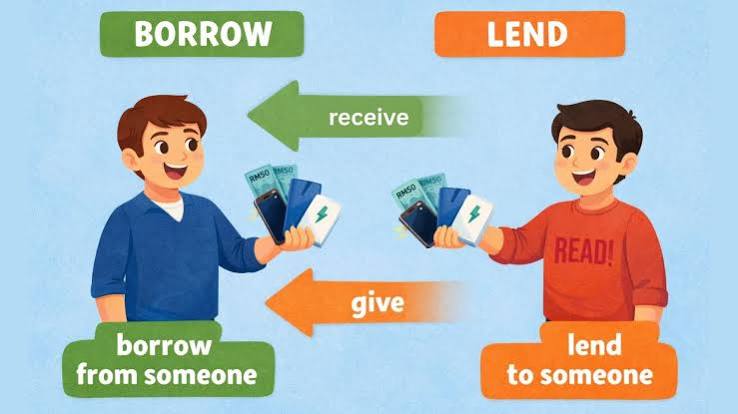
Let’s start with one of the most confusing pairs: borrow and lend. They describe the same exchange, but from opposite points of view.

Borrow = take something from someone for a while and plan to return it.

Lend = give something to someone for a while, expecting it back.

Online English grammar for beginners conversational English tutor

A simple way to remember


Think of the direction:

borrow ← receive
lend → give

So, if your friend gives you an umbrella, you borrow it. Your friend lends it to you. I borrowed an umbrella from Sarah.

For example:
I borrowed an umbrella from Sarah. Sarah lent me an umbrella.


The two verbs often appear in the same sentence because they describe the same situation from different perspectives. If you enhance your vocabulary, it is obligatory to keep in your mind.


Take this vocabulary quiz

Lie vs. Lay: Who Is Resting?

Another common source of confusion is lie and lay.

The easiest way to remember the difference is this:


Lie means to rest or recline. It does not take an object. In English grammar we call such verbs intransitive ones.

Lay means to put or place something somewhere. It does take an object.

Notice something tricky here: the past tense of lie is lay! 

So we have: lie → lay → lain


Lay = put something down


When you lay something somewhere, you put it there.

The verb lay needs an object. Learning English grammar, you come across a lot of transitive verbs like lay.

You lay something down.

Please lay the book on the table.

Its forms are: lay → laid → laid


online English grammar courses and tutoring - verbs confusing


Take this vocabulary quiz

Lie or Lay Quiz by Irene

Make or Do: A Simple Guide


Make and Do are two English verbs which are often confused. There are, however, some important differences which can help us choose the right verb.

A simple way to remember:


Use make to build or create something new, and use do for general tasks and activities. 


English online grammar tutor and difference do and make

Take this vocabulary quiz

Make or Do Quiz by Irene

Raise or Rise: what is the difference?

Raise and rise often cause confusion because both describe upward movement. The key difference? 

Raise needs an object, while rise does not. Let's learn how to use them correctly with simple rules, examples, and a vocabulary quiz.


English online tutor - vocabulary difference raise and rise

A simple way to remember:


Raise 
is a regular verb that means to put something up. Therefore, it is always followed by an object, the thing that you are raising.

For example, I raised my hand to answer the question.


Rise is an irregular verb that means to go up or increase. Since things rise by themselves, this verb does not take an object.

For example, the sun rises every morning.

Take this vocabulary quiz

Set or Sit: what is the point of confusion?
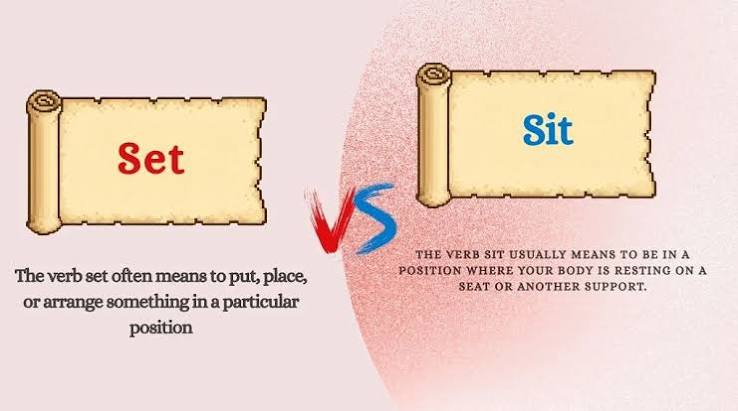
The main difference is that sit means to rest in a seated position, while set means to place or put an object down.

It is important to remember:

Use set with the following nouns:

  • Date e.g., The date for the next meeting has been set for 5 May.
  • Alarm e.g., I have set my alarm to wake me up at 5 p.m. tomorrow morning.
  • Example e.g., Set a good example for your kids by not using your phone at the dinner table.
Online English grammar tutor - difference set and sit

Learn more about Set and Sit

Take this vocabulary quiz

Set or Sit Quiz by Irene

Wrap up

By now, you should have a clearer understanding of some commonly confused verbs and how to use them correctly. Although these verbs may seem confusing at first, learning new vocabulary items, their meanings and seeing them in context can make a big difference.

Remember that practice is the key to mastering them, so don’t worry if you make mistakes along the way. Try the vocabulary quizzes again, review the examples, and pay attention to these verbs when you come across them in everyday reading and writing. With regular practice, you’ll become more confident in choosing the right verb and expressing your ideas clearly and accurately.


So, keep practising, embrace the challenges, and let your growing confidence guide you towards clearer, more accurate English! Happy learning!

Explore the world of English grammar and language learning with Theia Learn. 

See you soon!  
Start learning

Ready to take your grammar to the next level?

Dive into our Master the English Grammar Course, or start with the fundamentals from the free Introductory Grammar Course. You will find there multiple interactive contents including quizzes, vocabulary games, video lectures and printable materials. Enjoy!
Created with